Why home solar
The average American household uses more electricity every year, and utility customers end up paying for that growth. Large renewable projects cannot always match conventional plants in volume, but a home solar setup lets a household make its own power and save money over time. That gap is why our team chose domestic solar as our topic.
The four parts of a home system
Sunlight excites electrons in a semiconductor layer inside each photovoltaic cell, and that charge is collected as DC voltage.
Sits between the panel and the battery and controls how the battery charges and discharges.
Stores the DC energy as chemical energy until the home needs it.
Uses a switch and an oscillating signal to turn DC into AC, so the power works with home appliances and the grid. Excess power can go back to the grid through the meter.
My section: the battery and control system
The panels make power only when the sun is out, but a home needs power all day. The charge controller and battery solve that problem, and this is the part of the presentation I researched and presented.
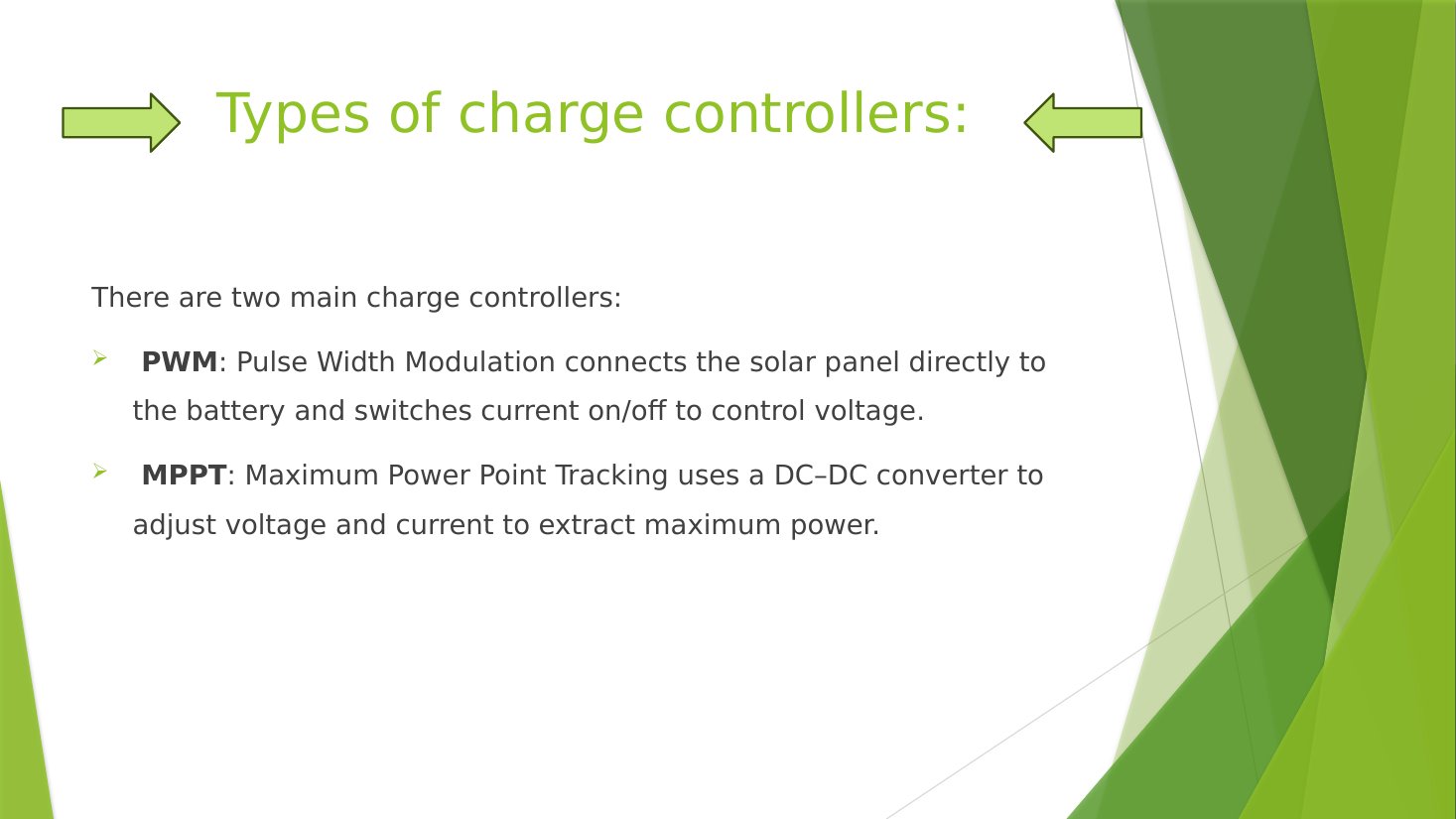
Two types of charge controller
Connects the panel directly to the battery and switches the current on and off quickly to control the voltage. Simple and low cost.
Uses a DC to DC converter to adjust voltage and current so the panel always delivers as much power as it can. More efficient, especially when the panel voltage is well above the battery voltage.
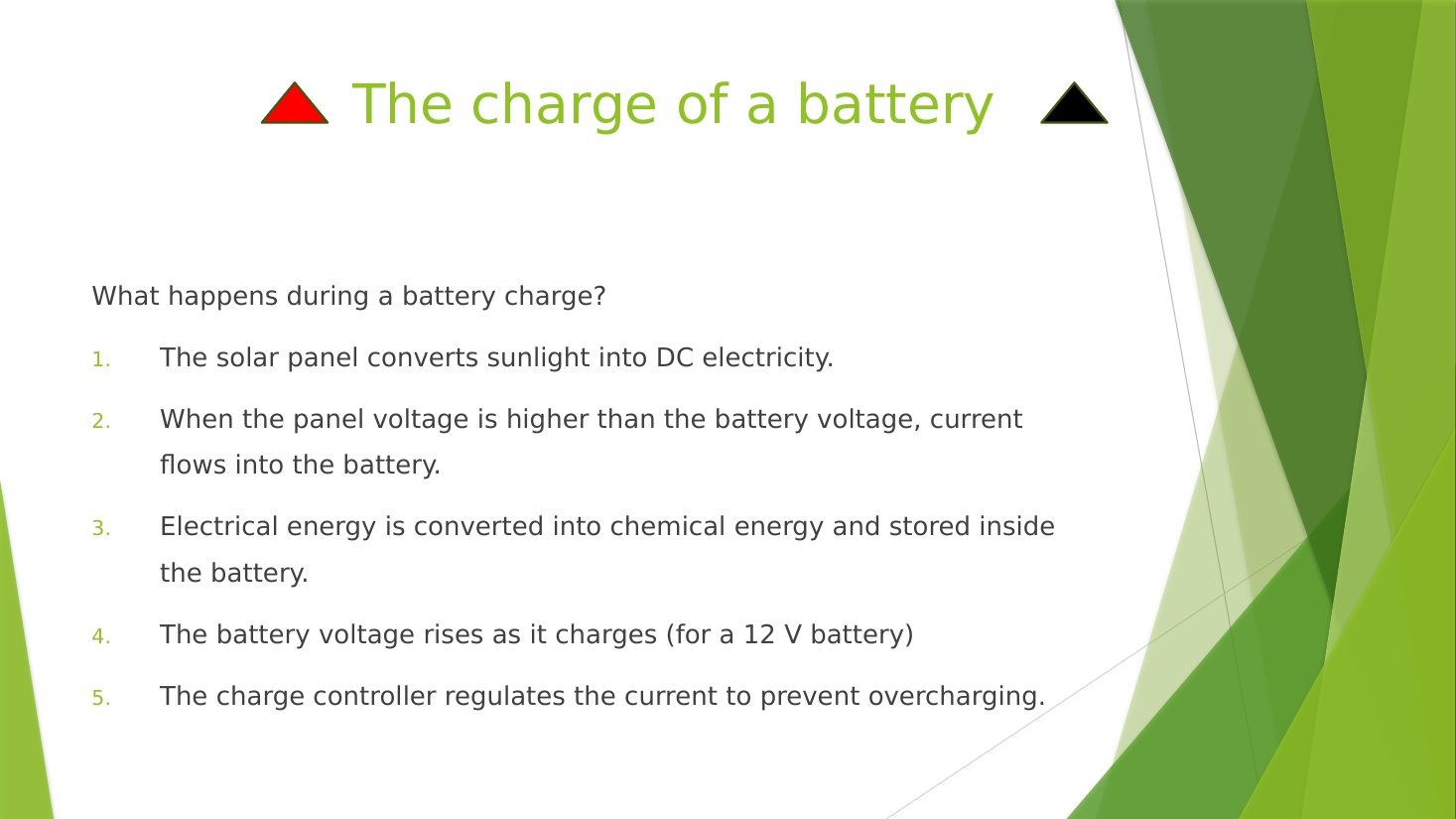
When the battery charges
- The panel turns sunlight into DC electricity.
- When the panel voltage is higher than the battery voltage, current flows into the battery.
- Electrical energy is stored as chemical energy, and the battery voltage rises.
- The charge controller limits the current so the battery is not overcharged.
When the battery discharges
- When the sun is gone or the panel voltage drops below the battery, current flows out of the battery.
- Stored chemical energy turns back into electrical energy and powers the load.
- The battery voltage slowly drops.
- The charge controller stops a deep discharge to protect the battery's life.
You can watch both of these happen in the model above. Play through a day and look at the status line under it.
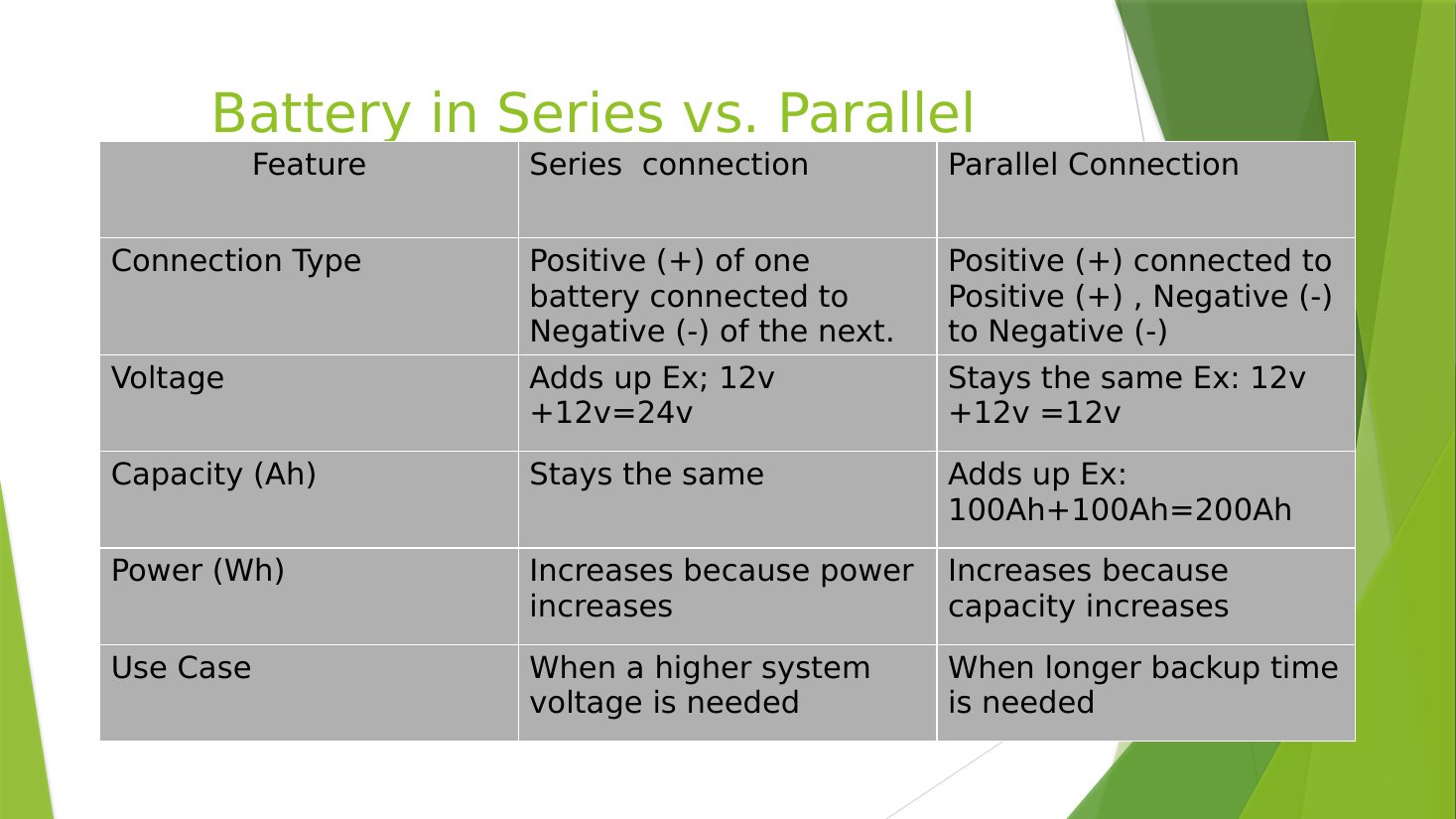
Connecting batteries in series or parallel
| Series | Parallel | |
|---|---|---|
| How they connect | Positive of one battery to negative of the next | Positive to positive, negative to negative |
| Voltage | Adds up, 12 V + 12 V = 24 V | Stays at 12 V |
| Capacity | Stays the same | Adds up, 100 Ah + 100 Ah = 200 Ah |
| Stored energy | Increases because voltage increases | Increases because capacity increases |
| Best for | A system that needs a higher voltage | Longer backup time |
Either way, stored energy is E = V × Ah. Two 12 V, 100 Ah batteries hold 2.4 kWh in series or in parallel. Only the voltage and current change.
What can go wrong, and how to prevent it
Clouds, rain, seasons, dust, and shade all cut panel output, which slows battery charging.
Clean the panels regularly and size the battery to cover days with less sun.
Heat lowers panel voltage and shortens battery life, and cold slows battery charging.
Give the equipment good ventilation and protect the battery from extreme temperatures.
Connections corrode and parts get damaged over time.
Check wiring for corrosion, inspect the controller and battery levels, and replace damaged parts early.
Leading the team
I divided the topic into three sections so each person owned one part, set check ins so we caught problems early, and made sure the sections connected into one story from sunlight to the outlet.
Leading means checking in early, matching tasks to people's strengths, and keeping everyone on one plan.
What I learned
- How a home power system fits together, from generation to storage to the load and the grid.
- Why the charge controller matters as much as the panel, and when MPPT is worth it over PWM.
- How series and parallel connections change voltage and capacity, which is the same thinking used in larger power distribution.
- How to lead a team and turn three people's research into one clear presentation.
From the presentation